


%20%20-%20Menu.svg)





Shipping API for Ecommerce: Full Guide + Comparison (2026)


In this blog
TL;DR Summary
Quick answer. A shipping API is a software connection between your ecommerce platform and one or more carrier networks. It automates label generation, rate shopping across carriers, real-time tracking, address validation, and returns in a single integration, so you stop logging into UPS, FedEx, and USPS portals by hand.
For stores shipping 100 or more orders a month, the math is simple: automation typically trims label handling time sharply, cuts "Where is my order" support tickets by more than half, and unlocks multi-carrier rate savings of 15 to 25 percent per label. With UPS and FedEx both setting a 5.9 percent headline rate increase for 2026 (and surcharge changes pushing the real figure higher for many shippers), rate shopping through an API has moved from nice-to-have to margin defense.
Our picks. Best for SMB and Shopify-first stores: Shippo or ShipStation. Best free tier for developers: EasyPost. Best for international shipping: Easyship. Best for high-volume, multi-carrier, multi-warehouse operations: ClickPost.
It is 9 p.m. on the Thursday before a long holiday weekend, and someone on your team is copying tracking numbers into a spreadsheet by hand, one order at a time. Two hundred rows in, the coffee has gone cold and a customer has already emailed asking where their package is. If that scene feels familiar, you are not running a shipping process. You are the shipping process, and that does not scale.
The stakes keep rising. The global parcel market is on track to reach roughly $538 billion in 2026, with an estimated 435 billion parcels moving worldwide this year alone. At the same time, UPS and FedEx each set a 5.9 percent headline rate increase for 2026, and new dimensional and surcharge rules push the effective increase closer to 8 to 12 percent for many parcels. Costs are climbing while manual work eats hours you cannot bill for.
A shipping API is the tool that breaks that cycle. In plain terms, it is a direct software connection between your store and the carriers, so labels, rates, tracking, and returns happen automatically instead of tab by tab.
This guide gives you a plain-English explanation of how it works, a pricing breakdown by order volume, an honest comparison table of the leading providers, and an integration checklist written for the person planning the project rather than the one writing the code.
Whether you are processing 50 orders a day or 5,000, you will leave with enough to choose, budget for, and implement the right shipping API without relying on a vendor's sales pitch.
Why manual shipping processes break, and when to replace them
The three warning signs your workflow needs an API
Most teams do not decide to automate shipping. They hit a wall and then decide. Three thresholds tend to mark that wall.
- Volume. Once you are hand-processing more than about 100 orders a month, shipping starts to swallow real labor, often several hours a day for one person. That time has a cost, and it grows every time sales do.
- Error rate. If mis-keyed addresses or wrong-carrier picks are slipping through more than about once every 50 shipments, each miss is expensive. Industry research puts the cost of a single failed delivery at around $17 per parcel in the US once you count reshipment and labor, before any lost customer.
- Customer experience. "Where is my order" tickets that climb past 10 percent of your order volume are a signal, not just a nuisance. That is exactly the range where automated, event-driven tracking notifications start paying for themselves.
What manual shipping actually costs
Run the numbers on a 300-order-per-month store. Say two staff hours a day go to shipping tasks at a blended $22 an hour. That is about $1,320 a month in labor before a single package moves. Now price the same 300 orders through a shipping API at roughly $0.03 a label: about $9 a month in API fees. The labor line dwarfs the software line by more than a hundred to one. You will rarely find a clearer case for automation anywhere in an ecommerce stack.
What is a shipping API?
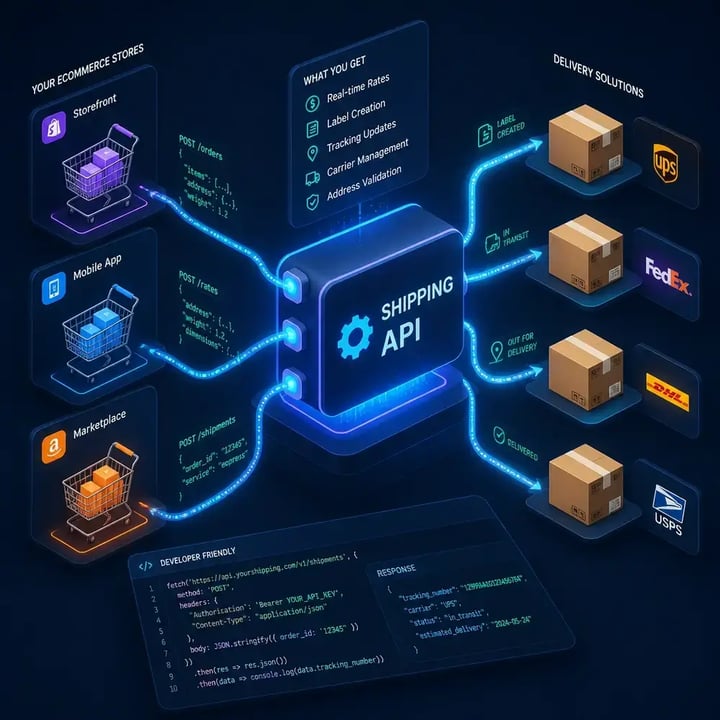
A shipping API (application programming interface) is a software connection between your ecommerce platform and one or more carrier networks, such as UPS, FedEx, USPS, or DHL, that automates label generation, real-time rate shopping, shipment tracking, address validation, and returns processing without manual portal logins or data re-entry.
Think of it as the wiring between your store and every carrier you use. Instead of a person opening each carrier's website, the API sends and receives the same information in the background, in a fraction of a second.
How does a shipping API work? A step-by-step view
- Order placed. Your customer checks out, and the order data (weight, dimensions, destination, service preference) passes to the API.
- API request sent. Your platform calls one or more carriers in real time, asking for available services and rates.
- Carrier responds with rates. Each carrier returns its services, transit times, and prices, usually within milliseconds.
- Service selected. Either the shopper picks a service at checkout, or a rules engine chooses the cheapest qualifying option automatically.
- Label generated. The API creates a compliant label with barcode, tracking number, and manifest data, then hands it back to your system.
- Tracking webhook fires. As the parcel moves, webhook events push status updates to your platform and, if you want, straight to the customer by email or SMS.
For most carrier APIs, that whole sequence runs in under two seconds. Doing the same thing by hand, logging in, keying details, buying the label, copying the tracking number, takes four to eight minutes per shipment. Multiply that gap by your monthly order count and the time savings stop being abstract.
The five core functions of a shipping API, and what each one saves you
Plenty of articles list what a shipping API does. Fewer tell you what each function is worth. Here is the practical version.
1. Multi-carrier rate shopping
The API queries several carriers at once for the same parcel and returns the cheapest option that still meets your service rules. This matters more in 2026 than it did a year ago: with carrier base rates up 5.9 percent and surcharges rising faster, locking into one carrier means absorbing the full increase. Merchants who route each order to its best-priced carrier typically save 15 to 25 percent per label versus a single-carrier default.
2. Automated label generation
One API call produces a carrier-compliant label with barcode, tracking number, and manifest data. The payoff is twofold: you remove the manual data entry that causes most failed deliveries, and you collapse label handling time at scale. It is the least glamorous function on this list and probably the one that saves the most hours.
3. Address validation
Before a label prints, the API checks and standardizes the delivery address against carrier and postal databases. Given that a failed delivery costs about $17 per parcel, catching a bad address is pure margin protection. Address verification at checkout can reduce address errors by a large margin, which is one of the highest-return, lowest-effort fixes available.
4. Real-time tracking with webhooks
There are two ways to learn where a package is. Polling means your system keeps asking the carrier for updates. Webhooks mean the carrier pushes an update the moment a scan happens. Webhooks win, because they let you tell the customer what is going on before they think to ask. Done well, proactive notifications cut "Where is my order" tickets by 60 to 70 percent within 60 days.
5. Returns label automation
The API can generate a prepaid return label at purchase or on demand through a branded returns page. The useful part is what happens next: a return label event can kick off a refund workflow in your order management system, closing the loop without anyone touching it. Returns are where a lot of shipping tools go quiet, so the ones that automate this end to end stand out.
Single-carrier vs. multi-carrier shipping APIs: which do you actually need?
The difference is straightforward. A single-carrier API connects you directly to one carrier, for example through the UPS developer portal. A multi-carrier aggregator API connects you once to a platform that already maintains links to dozens or hundreds of carriers, so you get rate shopping and carrier redundancy from a single integration.
A single-carrier API fits when: you have deeply negotiated rates with one carrier, your shipments look almost identical order to order, and your developers would rather not maintain more than one connection.
A multi-carrier aggregator fits when: you ship across zones, want to rate-shop, need a backup when a carrier has a bad day, or simply do not have engineers to spare on maintaining separate carrier integrations.
Answer three questions:
-
Do you ship with more than one carrier, or plan to within 12 months? If yes, lean multi-carrier.
-
Does your shipment profile vary a lot by size, weight, or destination? If yes, lean multi-carrier.
-
Are you at a volume where one carrier gives you contract rates below aggregator pricing? If yes, evaluate single-carrier direct.
If you answered yes to the first two and no to the third, a multi-carrier aggregator is almost certainly the right call. For most growing stores, it is not close.
How much does a shipping API cost? Pricing models explained by volume
Shipping API costs follow three models: per-label fees (commonly $0.01 to $0.05 per label), monthly subscriptions ($0 to about $99 a month for SMB tiers, $250 and up for enterprise), and usage-based pricing that blends the two. Several major providers, including EasyPost and Shippo, offer free entry points, so getting started can cost close to nothing for an early-stage store.
Cost by volume (illustrative). The table below models a per-label rate of $0.03 against a subscription equivalent, alongside the labor those orders would otherwise consume by hand. Treat the figures as planning estimates, not quotes.
| Monthly orders | Per-label model (~$0.03) | Subscription model | Labor hours saved |
Approx. labor savings ($22/hr)
|
| 100 / mo | ~$3 | $0 (free tier) | ~30 hrs | ~$660 |
| 500 / mo | ~$15 | $29 to $49 / mo | ~150 hrs | ~$3,300 |
| 2,000 / mo | ~$60 | $99 to $199 / mo | ~600 hrs | ~$13,200 |
What drives cost up: carrier surcharges passed straight through, address-validation or insurance add-ons, and premium support tiers. What to watch in a contract: minimum monthly commitments, overage pricing once you pass a tier cap, and per-carrier connection fees on some aggregator plans. Read the overage terms before you sign, because that is where a cheap headline price quietly becomes an expensive bill.
Best shipping API for ecommerce: provider comparison (2026)
The right shipping API depends on your order volume, carrier preferences, tech stack, and how much developer time you can spare. Below is a side-by-side look at leading platforms, ClickPost included, across the criteria ops teams actually weigh. Uptime figures are the numbers each vendor advertises rather than contractual guarantees, so confirm the SLA in writing before you commit.
| Provider | Carriers | Pricing model | Free tier | Shopify / Woo | Uptime (advertised) | Best fit |
| ClickPost | 600+ globally | Subscription + usage | Sandbox available | Native | 99.99% |
High-volume, multi-carrier, international, multi-warehouse
|
| Shippo | 85+ (some reviews cite ~40+) | Per-label + subscription | Yes (free Starter, pay per label) | Native | 99.90% |
SMB, Shopify-first
|
| EasyPost | 100+ | Per-label (usage-based) | Yes (up to 3,000 labels/mo) | Via plugin or custom | 99.95% |
Developer-centric, custom builds
|
| ShipEngine (now ShipStation API) | 60+ | Free + Advanced tiers | Yes (free dev/sandbox) | Native | 99.90% |
Mid-market, API-led
|
| Easyship | 250+ couriers (API markets 550+) | Subscription + usage | Yes (free ~50/mo) | Native | 99.99% |
International shipping
|
| ShipStation | Major carriers + 400+ integrations | Subscription ($14.99 to $349.99/mo) | No (30-day trial) | Native | 99.90% |
Multi-channel SMB, warehouse ops
|
How to read it: for a Shopify-first store that wants to start free, Shippo and EasyPost are the natural first calls. If international duties and taxes are your headache, Easyship earns its keep.
If you have outgrown a single region's carrier set or you route orders across more than one warehouse, ClickPost's multi-carrier network gives you the broadest carrier coverage on this list plus routing logic the others do not focus on. On third-party review sites, the field is tightly bunched: G2 rates EasyPost and Shippo at 4.2 out of 5, ShipStation at 4.3, and Easyship at 4.4.
How to integrate a shipping API: a practical checklist for non-developers
Most integration guides are written for engineers. This one is for the operations manager who has to plan the project, line up stakeholders, and manage go-live without personally writing the code.
Before you contact a developer or vendor
-
Document your current shipping workflow: which carriers, which portals, which systems receive tracking data.
-
Identify your order management system and whether it already has a shipping API connector.
-
Estimate monthly order volume and your projected 12-month growth.
-
List the carriers you use today and the ones you want access to.
-
Set your minimum uptime requirement (most ecommerce ops want 99.9 percent or better).
-
Plan a sandbox testing window: two weeks of parallel processing before you cut over.
Do you need a developer? The honest answer
For Shopify, WooCommerce, and BigCommerce, most major aggregators offer native apps that need zero custom development. You configure, you do not code, and you can often be live the same day. For a custom storefront or an ERP connection, you will need a developer for the initial hookup, but ongoing maintenance is light. A realistic timeline for a developer-assisted aggregator integration is three to ten business days from sandbox access to go-live.
Go-live readiness checklist
-
Sandbox tested with real scenarios: residential, commercial, oversize, and international.
-
Error handling confirmed. What happens when a carrier returns no rates?
-
Fallback carrier rule configured for a primary-carrier outage.
-
Customer notification templates live and tested end to end.
-
Returns workflow connected to your refund triggers.
Why ClickPost is built for ecommerce operations at scale
By the time you reach this section, you have done the hard thinking: whether you need multi-carrier, what the comparison table says, and how a go-live actually runs. So the question is narrow. If you land in the high-volume, multi-carrier, or cross-border camp, why ClickPost specifically? Three operational reasons, not a feature list.
Carrier breadth. ClickPost connects 600+ carriers through one API, spanning major US networks (UPS, FedEx, USPS, and regional players like OnTrac) plus international carriers. In a year where diversifying into regional carriers is a real cost lever, that breadth is the difference between negotiating from strength and taking whatever your one carrier hands you. New carriers can go live in about a day.
Multi-warehouse and 3PL routing. ClickPost's API supports multi-node fulfillment, routing each order to the best warehouse based on inventory and shipping-zone proximity, then to the best carrier from there. Most competitor articles skip this entirely, yet it is the dominant complexity for any brand shipping from more than one location. ClickPost reports roughly 22 percent lower logistics cost from automated carrier allocation.
Uptime and fallback. ClickPost advertises 99.99 percent API uptime with built-in carrier fallback, so a carrier-side outage during a Black Friday spike does not stop your labels. It also carries SOC 2, GDPR, and ISO compliance, which matters once procurement gets involved. Treat that reliability as operational insurance rather than a checkbox.
Next step: Explore ClickPost's shipping API documentation and request a sandbox account to test against your live carrier mix before you commit to anything.
Frequently asked questions about shipping APIs
What is a shipping API and how does it work?
A shipping API is a software interface that connects your ecommerce platform to carrier networks, automating label generation, rate shopping, tracking, and returns. It works by sending order data to carrier systems in real time and receiving rates, labels, and tracking events back within milliseconds, with no manual portal logins.
What is the best shipping API for ecommerce?
It depends on volume and tech stack. For Shopify-first SMBs, Shippo and ShipStation offer native integrations and easy starting points. For high-volume or international operations, ClickPost (600+ carriers) and EasyPost provide the broadest carrier coverage. See the comparison table above for a side-by-side.
How do I integrate a shipping API into my ecommerce store?
For platform-native stores like Shopify and WooCommerce, integration uses a plugin or app with no custom code. For custom storefronts, a developer typically needs three to ten business days to move from sandbox access to a live multi-carrier integration.
What is the difference between a single-carrier and multi-carrier shipping API?
A single-carrier API connects to one carrier directly. A multi-carrier API connects to many carriers through one integration, which enables rate shopping and carrier redundancy. Most growing ecommerce businesses benefit from the multi-carrier approach.
How much does a shipping API cost?
Costs range from $0 on free tiers to roughly $0.01 to $0.05 per label on usage-based models, or about $29 to $199 a month on SMB-to-mid-market subscription tiers. See the pricing table above for cost benchmarks by order volume.
Do I need a developer to set up a shipping API?
Not always. For Shopify, WooCommerce, and BigCommerce, most aggregators offer no-code apps. For custom storefronts or ERP systems, a developer is needed for initial setup, but ongoing maintenance is minimal.
What shipping APIs work with Shopify?
Shippo, ShipStation, Easyship, ShipStation API (formerly ShipEngine), and ClickPost all offer native Shopify integrations. Each installs through a Shopify app without custom development.
Can a shipping API reduce shipping costs?
Yes, mainly through multi-carrier rate shopping (saving 15 to 25 percent per label) and address validation that prevents costly failed deliveries at about $17 each. With 2026 carrier increases in effect, those savings matter more than they did last year.
What happens if a shipping API goes down?
A well-built integration includes fallback carrier logic: if the primary carrier API is unavailable, the system routes to a backup automatically. When evaluating providers, require a 99.9 percent or better uptime figure and ask specifically how carrier-side outages are handled during peak periods.
What is the difference between a shipping API and shipping software?
Shipping software is an application you log into and operate by hand. A shipping API is a programmatic interface: your systems talk to carrier networks directly, with no human in the loop. Most shipping software actually runs on a shipping API under the hood.
Start with the right foundation
Strip away the detail and the argument is short. In a 2026 where the big carriers are raising rates and manual labor costs compound every month, a shipping API is not a technical nice-to-have. It is a lever on your margin, and one of the few you fully control.
Where you go next depends on who you are. If you are a founder buying your first API, open a free-tier account on a multi-carrier aggregator and run it in parallel with your manual process for two weeks before you cut over. If you are an ops manager building the business case, use the labor math and pricing table above to frame the return in numbers your CFO can act on. And if you are a fulfillment lead weighing multi-carrier, multi-warehouse routing, ClickPost's 600+ carrier network and node-routing is built for exactly that complexity.
The payoff runs beyond cost. As Shopify President Harley Finkelstein has noted, delivery-date transparency is a revenue lever: "providing greater visibility and confidence in delivery dates can help improve their store conversion". A shipping API is what makes that kind of visibility possible at scale, which is why, for any store past 100 orders a month, it is where the work starts.




Reduce RTO by 25% in 90 days
Learn how to flag at-risk deliveries, recover failed ones, and act on the warning signs early.